On the second floor of Hany Armanious’s exhibition at Buxton Contemporary in Melbourne, a curl of tangerine peel lies on a shelf, its yellowing, pithy insides facing upwards. It feels like it should be cleaned up, but it won’t be. The rind is not rubbish discarded by a careless visitor: it’s a perfect resin cast made by Armanious.
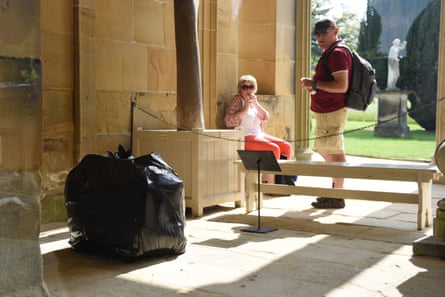
Placed carefully around the gallery are resin recreations of other items more commonly seen in bins: a group of melted candles, blobs of Blu-Tack, crumbly chunks of polystyrene. These might seem unlikely subjects for an exhibition, but Armanious is one of several artists who have turned their eye to trash in recent years. Gavin Turk, Ai Weiwei, Susan Collis and Glen Hayward, among others, all go to similarly painstaking – and often expensive – lengths to recreate items that most people would not look twice at. Trompe l’œil sculptures of rubbish have been exhibited in museums around the world and fetched high prices at galleries and auctions. In October, a pile of six garbage bags cast in bronze by Turk sold for £82,550 (roughly AU$167,000) at Sotheby’s in London.

An understandable reaction to Armanious’s shrivelled peel or Turk’s pricey bin bags is: are they a joke? Partly. They are undeniably playful, the artistic equivalent of “is it cake?”, the trend of bakers crafting lifelike replicas of everyday objects out of sponge and icing that swept TikTok, then reality TV.
Armanious’s creations are the latest in a long line of artworks connected to rubbish. Pablo Picasso and Georges Braque began incorporating scraps of wastepaper into their paintings in 1912. Five years later, Marcel Duchamp famously exhibited a porcelain urinal, an item manufactured to dispose of waste, as art. Ever since, artists have incorporated actual junk into their work to prompt reflection on which objects we value, and why.
Creating the illusion of litter, however, is a largely 21st-century phenomenon and artists are pursuing it to varying effect. For Armanious, the labour of making an object, rather than finding one and rebranding it as art, deepens viewers’ investment in it. “The question that’s always asked is: why not just show the real thing? Why bother?” Armanious says. “The answer being, if I didn’t bother making it, you wouldn’t be bothered looking at it.”
Sometimes it isn’t always clear what is rubbish and what is art: in 2001, a cleaner in a London gallery accidentally threw out full ashtrays, half-filled coffee cups, empty beer bottles and newspapers that were actually an artwork by Damien Hirst. The same thing happened again at Sala Murat in Italy in 2014 – and again last year, when some crumpled beer cans made by French artist Alexandre Lavet were mistaken for rubbish in a Dutch gallery.

Producing something new also allows artists to play with materials to comment on what we deem worthy of our attention. In 2008, the British artist Susan Collis had an exhibition at Ingleby gallery in Edinburgh. But on opening night, there was no obvious artwork in sight, just a broom, some screws in the wall and a paint-spattered wooden block on the floor. It was only when visitors looked more closely that they discovered treasure in the detritus. The screws were made from 18-carat white gold and studded with sapphires, while the paint drops and dirt caked on to the broom were opals, pearls and other gemstones.
Similarly, for Ai Weiwei’s 2023 exhibition at the Design Museum in London, he made precise marble recreations of a roll of toilet paper and a polystyrene takeaway box, complete with chopsticks. In normal times, these objects would be considered almost worthless, but during the Covid-19 pandemic they became worth their weight in gold.

This heightened questioning of what we value is particularly urgent in our age of climate crisis. Turk made his first bronze bin bag in 2000 and has since made replicas of cardboard boxes, apple cores and much else. (Apples cores are also a favourite subject of Glen Hayward, who carves similar pieces out of wood.) Turk has talked regularly about how we are defined by our rubbish – “We are what we throw away,” he previously told the Guardian – and his bulging bags reveal us to be greedy and wasteful.
after newsletter promotion
At their most successful, uncanny sculptures not only comment on society, but force us into uncomfortable self-reflection and our slippery sense of reality. When it is increasingly difficult to parse what is fact or fiction, these artworks also make us question how much confidence we can place in our senses. They test the limits of our sight and, by extension, how we understand the world.

Armanious’s replicas in particular are so accurate that gallery-goers must suspend their disbelief and trust that they truly are casts, not just found items. At Buxton Contemporary, the experience of trying to decipher them becomes a physical and mental task. Some sculptures are placed on the floor, others secreted on windowsills, yet more hung high on the walls, urging people to crouch and tiptoe as they try to look more closely at the works – all while watching their step. The effect is simultaneously unsettling and invigorating.
It’s also fun, something that’s not always associated with contemporary art. “If you’re not enjoying the work, and having serious fun, then it’s not working,” says Armanious. “Fun is quite a serious state: it’s fully engaged, amused and curious.”
Curiosity is perhaps the word that best describes the feeling engendered by Armanious’s mind-boggling creations. They are so inconceivable that it is tempting to reach out and touch them, to feel the difference between his copies and the originals. But please don’t – it is art, after all.
-
Hany Armanious: Stone Soup is at Buxton Contemporary Melbourne until 11 April