- Have YOU got a story? Email tips@dailymail.co.uk
Monks living at a manor gifted to them by Beatles star George Harrison have been accused of turning it into a money making ‘spiritual theme park’.
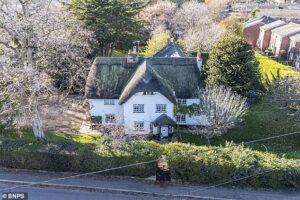
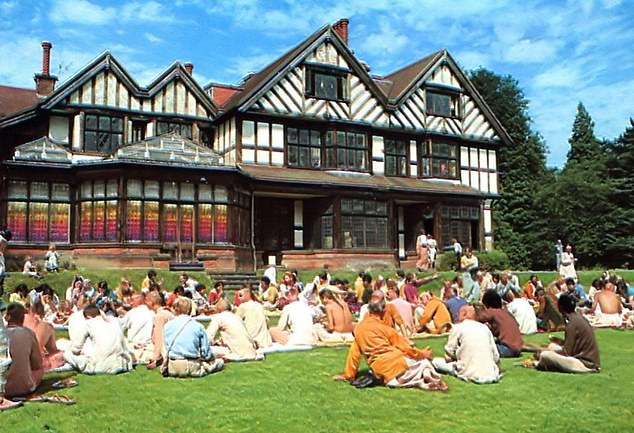
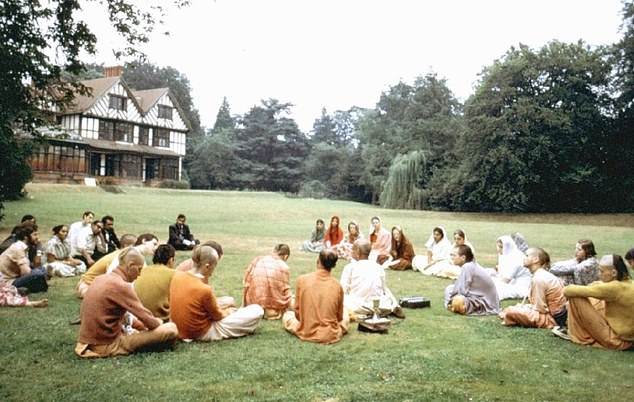
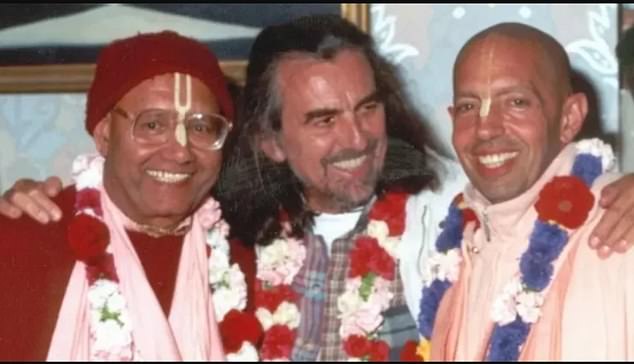
Bhaktivedanta Manor, a stunning 17th Century estate in Letchmore Heath, near Watford, was given to the Hare Krishna movement in 1973 by Harrison and a cow sanctuary on the site opened that same year.
Nestled in tranquil countryside, it is spread over 77 acres and includes a goshala (cow shelter), organic farm, lake, prayer and eating halls, attracting thousands of visitors from all over the world.
But in recent years the site has undergone an ‘unacceptable’ amount of development, critics say, in what they claim is a ‘strategic transformation’ by the monks to generate cash.
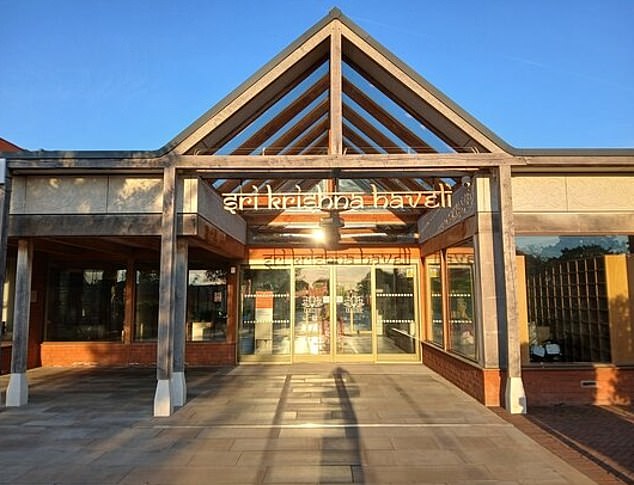
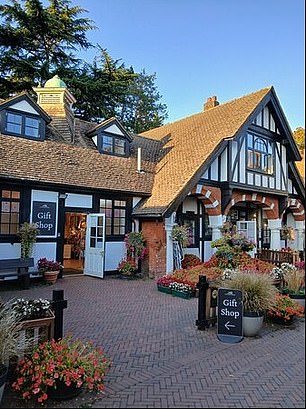
Among proposals, some of which have gone ahead without planning, are a new restaurant, café, bakery, kitchens, book shop, gift shop and children’s play area.
Refurbishment of a Goshala [cow shelter], two new agricultural barns, Oxen cart tracks, footpaths, a new accommodation block and a new 10,000sq ft glasshouse have also been proposed.
Bhaktivedanta says the plans are part of efforts to ‘enhance and expand the visitor experience’ at the site where admission is free but classes such as yoga and farm workshops are not. The Manor and its farm, home to a 63-strong sacred herd of cattle, are thought to attract over 100,000 visitors a year, including 22,000 school children.
But Letchmere Village Heritage Trust (LHVT), a local group who fiercely oppose the expansion plans, say Bhaktivedanta has gone ‘far beyond the limits of ancillary religious activity’ noting how in just 15 months, six retrospective planning applications were lodged with Hertsmere Borough Council by the monks for a range of projects.
They fear the Manor is ‘ignoring the planning system’ as part of a ‘worrying pattern of non-compliance and an attitude of only making applications on a minimal ‘needs must’ basis’.
LHVT are among a range of objectors including parish councillors, residents and the Radlett Society, a local heritage and green belt preservation group, who are growing increasingly concerned the site is being used to maximise revenue and could be planning to host higher footfall events.
Tensions boiled over following an incident that triggered ten hour tailbacks on the M1 after the Manor released religious festival tickets for free.
Resident Mike Sullivan fumed: ‘I’ve been in this area a long time and over the years, the Manor has gone from a place of religious worship to a business and that’s not right.
‘The number of people has been steadily increasing, the traffic has been getting worse and at times, it’s incredibly noisy. These monks appear more interested in running the manor like a commercial business. It’s more a theme park than a place of spiritual refuge.’
Dimea Balgoh, 47, said: ‘There are a lot of buildings on the Manor, and it can get very busy. There’s lots of visitors at weekends and during religious festivals and lots of locals are worried that it could get worse if new plans are approved.’
Barney Clark, 63, who runs a pest control business, said: ‘This is a Green Belt area, and we are all concerned about these developments. It shouldn’t be allowed, it’s ridiculous.’
In a blistering four page letter in May objecting to work that had gone ahead without planning on a Grade-II listed building known as the Stable Block – where a new bakery, eatery, gift shop, bookshop, accommodation, children’s play area and toilets will be built – the group said: ‘The nature and intensity of the combined developments are far beyond the limits of ancillary religious activity and all must be assessed as a change of use.
‘An alarming intensification of food production and restaurant offerings appears to be taking place.
‘On Holland Farm, five modest polytunnels are proposed to be replaced by a huge glasshouse, over 10,000 sq. feet, a café is to be introduced into the Goshala, a training kitchen is proposed for the accommodation block at Holland Farm and an eatery/restaurant at the Stable Block.
‘This is compounded by the recently submitted 25/0124/FUL for Holland Farm accommodation block, and 25/0138/FUL for Goshala works, (including new café, much expanded farm shop and other changes of use), barns and glasshouse along with pedestrian and oxen paths.
‘There are other commercial enterprises proposed as evidenced by the current applications.’
Each application should be considered not as isolated but ‘as part of a strategic transformation of the site from a place of worship into a public-facing commercial and leisure destination’, LVHT added.
Documents reveal the Manor has been visited by planning enforcement after already completing well over half of the works in the Stable Block, with gift and book shops, children’s area, toilets, bathrooms and windows all in place, despite not having any planning permission.
When it emerged the monks had plotted to refurbish the Goshala (cow shelter), erect two new massive barns, build Oxen cart tracks, pedestrian footpaths, and replace existing polytunnels with a 10,000 square foot greenhouse, LVHT filed a 23-page objection letter.
The Radlett Society and Greenbelt Association alleged there was a ‘seeming intention of the Manor to become a commercial operation rather than a religious community with some supporting commercial aspects’ and blamed it for ‘regularly’ starting work without planning permission.
They added how the projects ‘will have a huge impact on the adjacent local communities and their village life’ while environment experts have warned of increased flood risks.
Tense meetings are now being held between the Manor and local residents, a local source told the Mail.
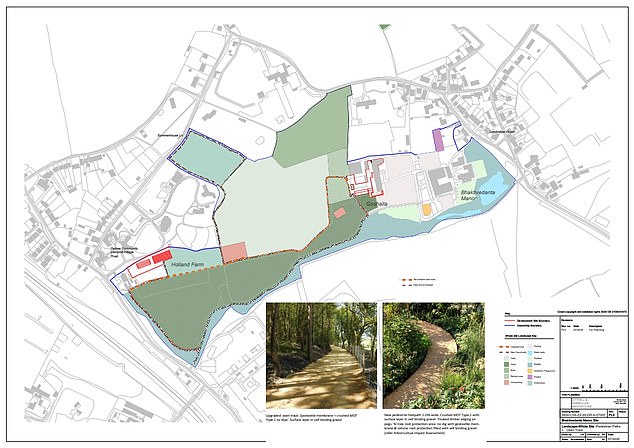
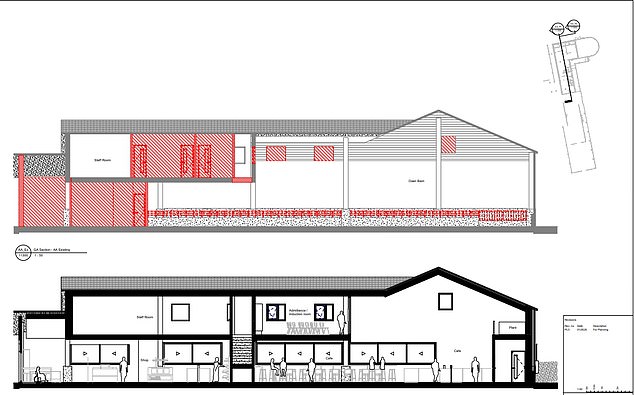
The addition of 14 en-suite bedrooms has left locals fearing the site will host yoga retreats on top of farm workshops held at the estate’s New Gokul farm and vegetable growing Holland Farm. Residents have repeatedly warned the area will struggle to deal with the footfall the Manor is appearing to be expanding for.
Objectors also note how the plans go against the Manor’s 2012 Supplementary Planning Document (SPD) which stated ‘the general level of use is to continue to be regulated to the existing levels’.
The row has triggered a protracted war of words that’s seen the monks send out rallying cries to the global Hare Krishna movement to back their expansion plans.
The call to arms led to hundreds of comments supporting plans on the Hertsmere Borough Council planning website from devotees across the world.
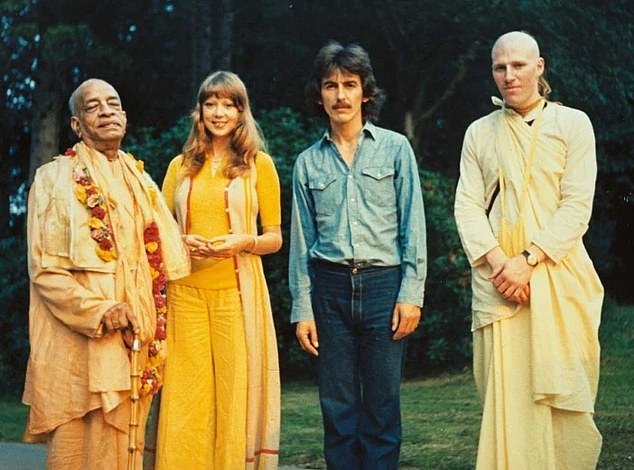
The Hare Krishna movement, formally known as the Gaudiya Vaishnava tradition, was brought to the west in 1965 by A.C. Bhaktivedanta Swami Prabhupada a.k.a. Srila Prabhupada.
While it is a branch of Hinduism, Hare Krishnas solely worship the Hindu deity Krishna, the god of protection, compassion, tenderness, and love, who they consider the Supreme Lord, and believe the soul is locked in an eternal cycle of reincarnation.
George Harrison became interested in Hinduism after the Beatles visited the ashram of Maharishi Mahesh Yogi in Rishikesh, northern India, in February 1968 to take part in a Transcendental Meditation training course. The band say it helped wean them off drugs.
That December, Harrison met Hare Krishna missionary Shyamasundar Das at an Apple Records party and in 1973 gifted Bhaktivedanta Manor to the movement.
Devotees follow a specific form of yoga called ‘bhakti yoga’, or the yoga of love and devotion towards Krishna.
Harrison’s 1971 number one hit ‘My Sweet Lord’ is a tribute to Krishna which includes Hindu chants and Vedic prayer. The lead guitarist went on to release several albums with acclaimed Indian sitarist Ravi Shankar before he died in 2001 aged 58.
Controversies at Bhaktivedanta, however, haven’t remained inside the temple gates.
Locals have also been left bemused by the 2012, 2015, 2016 and 2022 purchases of four properties in the neighbouring village of Letchmore Heath for the monks.
They say the fact monks are requiring additional accommodation off-site is proof Bhaktivedanta has further intensified its activities and is tearing up its SPD promise.
In an ironic planning battle of their own in February, Bhaktivedanta successfully blocked proposals for a nearby battery energy storage site after monks claimed it would ‘negatively impact the health of the sacred dairy herd’ and could wreck the ‘peaceful environment’.
The temple yet again sparked controversy in August, when an alleged ‘admin error’ resulted in the release of too many free tickets for their Janmashtami festival, which celebrates Krishna.
The blunder triggered a ‘ten hour nightmare’ gridlock stretching back to the M1 as 70,000 devoted Hare Krishnas attempted to enter Bhaktivedanta Manor. Festival-goers complained of pushing and shoving and a lack of volunteers to manage the queues.
The Manor has applied to spread the 2026 festival over three days instead of two.
Alan Lambert, LHVT Chairman, refused to issue a full comment but told MailOnline: ‘The local community and Village Trust is currently in discussion with The Manor concerning a range of issues and concerns.’
Mrs Sarah Heighton, Chair of the Open Spaces committee at Aldenham Parish Council, said the site had been ‘overdeveloped’.
A spokesperson for Bhaktivedanta Manor told The Daily Mail: ‘Bhaktivedanta Manor remains a place of worship, spiritual reflection and service, as it has done for the past fifty years.
‘Bhaktivedanta Manor is a registered charity and does not operate for profit. All accommodation and facilities exist solely to support our resident monastic community and congregation.’
They added: ‘We continue to work collaboratively with Hertsmere Borough Council and remain committed to being a considerate and cooperative partner to residents and the local community.’