Today is the day when millions of people start opening their Advent calendars, but they didn’t always have chocolate in them. In fact, something unlikely inspired the sweet twist

As we officially move into December, people will be really getting into the festive spirit, especially due to their Advent calendars that will allow them to count down to the big day in style. However, little you may know, they haven’t always been filled with chocolate for people to feast on during the Christmas period.
In fact, you should probably pay thanks to a specific brand on December 1 as, if it wasn’t for the chocolate company, we may not be able to sample a delicious treat each day. Many people are only now realising the reason why chocolate became such a big part of the festive countdown, and the story may take you by surprise.
The topic recently came up on Reddit when people started talking about Advent calendars. One user wrote: “Do Advent calendars always have chocolate in them?
“I’m trying to buy a London-themed Advent calendar and I am confused, because they don’t state they have chocolate in them, or anything in fact. Been on a couple of websites where this has been the case.
“Is it a thing to have empty Advent calendars – with say images behind the windows instead of chocolates? Or can I assume these calendars do have chocolate?”
The question got a lot of people talking, and they were quick to comment. One person was swift to respond with: “Traditional Advent calendars will just have pictures behind flaps, no chocolate.”
Another added: “Traditional Advent calendars just have different images behind the doors. If they have chocolate inside it will say along with an ingredients list.”
A third replied: “Not all Advent calendars have chocolate, no. It’s common, particularly for those aimed at children, but it’s certainly not universal. There could be just pictures.”
Meanwhile, a fourth also commented: “Not always, no. Most do. All the ones in my main supermarket do for example. But all those ones very clearly specify as much, so if you see one that doesn’t I wouldn’t assume it has chocolate in.”
You may be wondering how chocolate came to be found inside Advent calendars, and the answer is pretty simple. If you’re a fan of Cadbury, you may already know.
Why is there chocolate in Advent calendars?
Back in the day, traditional Advent calendars generally contained religious images or verses behind each of the 24 doors, while the more modern “traditional” calendars often feature a picture behind each door. The concept of chocolate calendars wasn’t actually introduced until later down the line.
Early calendars, dating to the 1850s, tended to place focus on the spiritual aspect of Advent, with pictures of biblical stories, nativity scenes or small verses. It’s reported the first chocolate Advent calendars appeared in Germany in the 1950s.
Chocolate makers saw the opportunity to combine tradition with a daily sweet treat. Instead of a picture behind each door, a small piece of chocolate was placed inside each opening.
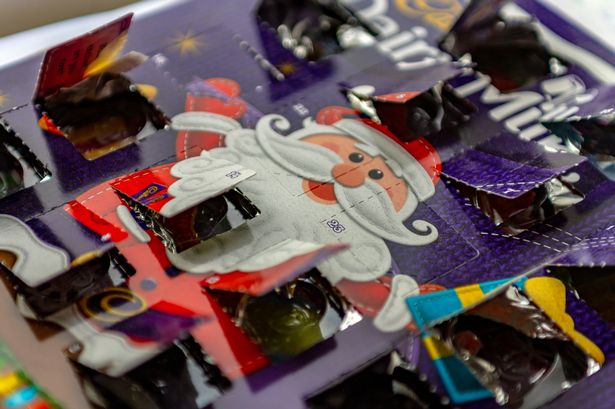
In 1971, Cadbury decided to launch its own variation, and this is when the tradition became more widespread. The brand may not have inspired the movement, but it certainly helped to make them more popular.
They weren’t actually put into continuous production until 1993, but Cadbury’s 1971 launch was a huge factor in making chocolate advent calendars a UK-wide tradition.