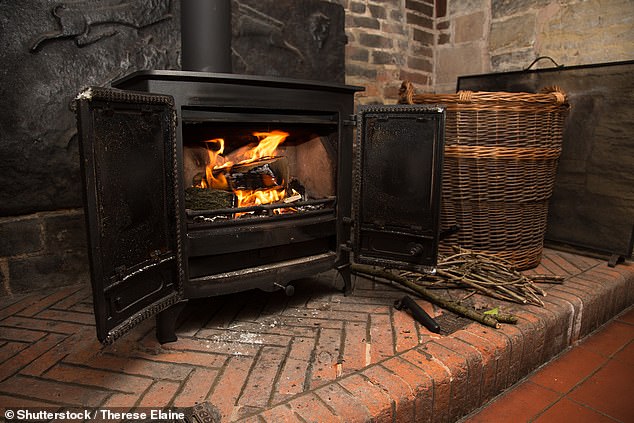
Wood-burning stoves could be consigned to the scrapheap under tight new rules on air pollution that have been introduced by Labour.
Environment secretary Emma Reynolds said today that a new environmental improvement plan (EIP) – the first of the Starmer government – would set ‘delivery plans’ for targets in line with those in the EU.
Among the pollutants targeted in the new plan released today are PM2.5 particulates – fine matter that includes byproducts of burning wood such as soot.
These are so small that they can penetrate deep into the lungs and enter the bloodstream if inhaled, and are considered the most harmful pollutant to human health by the World Health Organisation (WHO).
The UK’s current PM2.5 target is an annual mean concentration of 20 micrograms per cubic metre (μg/m³) of air. This was set under the 2023 plan in line with EU standards at the time.
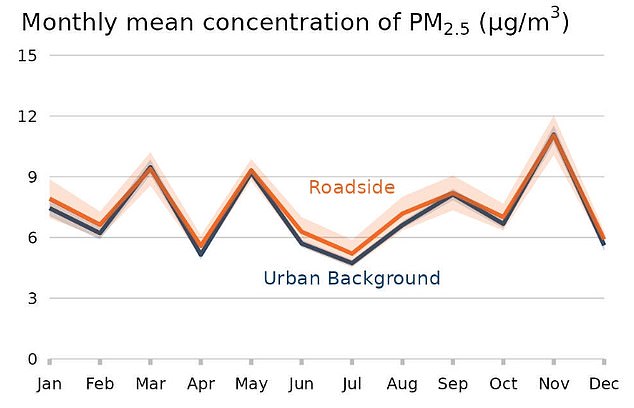
Average levels sat at 7.2μg/m³ throughout 2024, peaking at 11.1μg/m³ in November – blamed on heavier use of wood and coal stoves as the temperature drops.
But Brussels now has a stricter average of 10μg/m³ from 2030 – 10 years earlier than the current target for England, and above the levels recorded in the winter months.
The Government has said today it intends to match the European target – superseding the goals set under the Environment Act by the Conservatives.
The EU eventually aims to cut its target to the WHO-recommended level of just 5μg/m³ and it is likely that Britain will follow suit. In order to meet those targets, ‘biomass’ burners like stoves could face the chop.
Sources in the Department for Environment, Food and Rural Affairs (Defra) told The Guardian that a consultation on the EIP could see pollution limits tightened in smoke control areas.
These already dictate the types of fuel that can be used to ‘smokeless’ fuels that do not release smoke out of chimneys.
But the rules could be tightened to limit the types of stoves that can be used – effectively amounting to a ban on older appliances and, in some areas, a ban on the use of wood-burning stoves altogether.
Environment Secretary Emma Reynolds told the newspaper that the last EIP under the Tories was ‘not credible’, adding: ‘I’m confident that our EIP is credible, because it’s got these delivery plans built in.
‘You can’t just set the targets. You’ve got to explain how you’re going to achieve those targets. And that’s exactly what we’ve done.’
The EIP itself says the Government will ‘consult on new measures that cut emissions from domestic combustion, whilst minimising the impact on those that need to burn’.
Industry group HETAS, which certifies the environmental standards of wood-burning stoves, has backed the Government’s move for tighter standards – adding that many of the latest stoves are likely to meet any new target.
Head of technical services Calvin May said: ‘Wood burners, multifuel stoves, and pellet stoves that meet Cleaner Choice standards already meet potential EIP targets, demonstrating that industry is well-prepared for this change and committed to improving our air quality.’
WHO says PM2.5 particulate can exacerbate the symptoms of existing heart and lung conditions such as asthma, COPD and heart disease.
It has also been linked to a greater risk of asthma in children and adverse foetal development in pregnant women.
A study published at the end of September suggested that exposure to wood-burning stoves may be as harmful as smoking; another, published last month, linked their use to 2,500 deaths in Britain each year.
Wood-burning and other domestic combustion is thought to account for 20 per cent of UK PM2.5 emissions in 2023.
Elsewhere, the environmental improvement plan includes a commitment to restore or create 250,000 hectares of wildlife habitats by the end of 2030, and a plan to allocate millions to landscape recovery projects, working with farmers and landowners.
The EIP also renews a commitment to ensure 80 per cent of new cars and 70 per cent of new vans sold in the UK will be electric by 2030.
Electric vehicles emit less PM2.5 particulates because they are zero-emissions from the tailpipe – but studies have suggested they give off greater amounts from tyres and brakes because of the extra weight added by batteries.
In April last year, the Scottish Government quietly banned allowing wood-burning stoves as a primary heat source for new-build homes, prompting fury from those living in off-grid rural communities not connected to the gas network.
The outcry forced the hand of SNP ministers, who rolled back on the decision at the end of 2024. A ban on gas and oil boilers in new-build properties remains in effect.