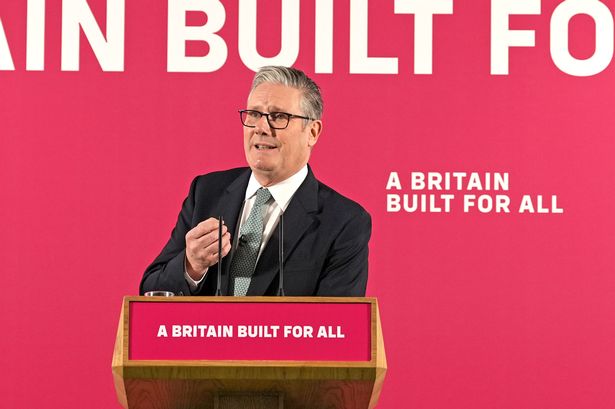
In a speech in central London Keir Starmer said the Budget was a ‘moment of personal pride’ as he defended a £26billion tax hike and defended Chancellor Rachel Reeves
12:22, 01 Dec 2025Updated 12:22, 01 Dec 2025
Keir Starmer insisted there was “no misleading” by Rachel Reeves ahead of last week’s Budget – which he branded “a moment of personal pride”.
In a speech in London the PM defended his Government’s £26billion tax hike as he claimed the UK is through “the narrowest part of the tunnel” on the road to recovery. He said the botched Brexit deal and years of Tory austerity had cost the country dearly.
And defending the decision to lift the two child benefit limit, he said too many working families are struggling to make ends meet. Mr Starmer vowed to reform the welfare system – but refused to say whether he was prepared to again suspend MPs who rebel.
Here we look at some of the key things we learned.
1. ‘No misleading’ by Rachel Reeves
Unsurprisingly the Prime Minister faced a lot of questions over whether Rachel Reeves had misled the public ahead of the Budget.
The Chancellor is at the centre of a storm after suggesting she had a black hole in the national coffers to fill – when forecasters had estimated there would be a small surplus.
Mr Starmer came out fighting, saying: “Let me just step through that in some detail, because there was and OBR productivity review, the result of that was £16billion pounds less than we might otherwise have had.
“That’s a difficult starting point for any Budget. We had already made commitments, which I think I’ve expressed to you of many others many times over, that we were going to protect our public services, particularly the NHS, to cut borrowing costs and to bear down on the cost of living.
“So we have, on the one hand, £16billion less than we might otherwise have had. We had clear commitments that we’d made throughout the process as to what it was we were going to achieve.
“Therefore, against that backdrop, it was inevitable that we would always have to raise revenue. So there’s no misleading there.”
2. Must be grown up with EU after botched Brexit deal
The PM has said the Tory Brexit deal caused huge harm – and said the country must be “grown up” in its relations with Europe.
He said that the country must have a closer relationship with the EU in a veiled swipe at Nigel Farage and Reform. The Prime Minister said: “And let me be crystal clear there is no credible economic vision for Britain that does not position us as an open trading economy. So we must all now confront the reality that the Brexit deal we have significantly hurt our economy.
“And so for economic renewal, we have to keep reducing frictions, we have to keep moving towards a closer relationship with the EU, and we have to be grown up about that to accept that this will require trade offs. That applies to our trading relations right across the world.”
3. Refuses to say if he’ll suspend MPs if they rebel on welfare
Asked by The Mirror’s Lizzy Buchan whether he’s prepared to once again suspend Labour MPs who oppose welfare reform, the PM claimed there is a “consensus” something must be done.
He responded: “Well, on this issue, welfare, I’m focusing particularly on young people. I do think, there’s a general consensus that is a moral mission.
“I mean, there aren’t many people who are comfortable with, nor should they be, the fact there’s nearly a million young people who are stuck with not earning or not learning. “
And he continued: “My big worry is that all of the evidence I’ve seen, shows that if at that age, that’s the situation, the likelihood is it’s going to go on for decades and that’s going to impact that cohort. There’s a strong consensus that we must do something about that.”
4. Too many working families struggling to pay bills
The PM said “too many” working parents are struggling to make ends meet.
Defending the decision to lift the two-child benefit limit, he said people are working “harder and harder” but finding it hard to pay bills. He described his own experience as a child of having to have the phone cut off.
The Prime Minister told the audience in London: “Three quarters of children growing up in poverty today come from working families.
“And some of the parents I met downstairs, some of the parents I met in Rugby when we were on the road last Thursday, they told me, as so many parents do, that they’re working harder and harder, but their wages struggle to meet their costs and I know what that feels like.
“I remember my family sitting around the kitchen table worrying about the bills. How are we going to pay them all? And we as a family couldn’t pay them all. And that’s why in our case, our phone was cut off.
“And that is still the reality of Britain for far too many people. And so yes, I am proud.”
5. Budget was ‘a moment of personal pride’
The Prime Minister said the Budget was a “moment of personal pride”.
He said the Government is focusing on improving public services, the cost of living crisis and unlocking potential across the country. He said whole parts of the nation had been “ignored as sources of growth” – something he plans to put right.
Mr Starmer stated: “And that’s why the budget was a moment of personal pride for me. I do not want to see a country where children grow up in poverty.
“I don’t think anybody in this country wants that. It is a fundamental British belief that every child should go as far as that talent will take them, and poverty is a barrier to that.”
6. Austerity and Brexit held Britain back
Mr Starmer has said Brexit and austerity contributed to low productivity, which is holding Britain back.
He said: “As the budget showed, the path to a Britain that is truly built for all requires many more decisions that are not cost free, and they’re not easy.
“We can all see the challenge low productivity, the result of an economy scarred by austerity, by Brexit, and by consistently failing to unlock the nation’s potential.
“So we need a productivity revolution. That’s our plan.”
7. Defiant message to tax critics
The PM defended the decision to raise £26billion of taxes – saying it will improve public services and tackle poverty.
Mr Starmer admitted doing so would cost people more, but said it was the right thing to do. He told the audience: “Politics is always about making choices.
“We could have cut public services. We could have ignored child poverty. We could have rolled the dice with extra borrowing.
“But I firmly believe that those options have been tested to destruction. I mean, we all know the risks of reckless borrowing.
“That is the path that Liz Truss took, and you can see the cost in any bill, mortgage, carload, anything affected by interest rates.”
8. ‘We’re through narrowest part of the tunnel’
Mr Starmer insisted the country is well on the path to better days, saying it has passed the “narrowest part of the tunnel”.
He said: “We have now walked through the narrowest part of the tunnel.” But he admitted the cost-of-living crisis has not gone away, adding: “In the year ahead you will see the benefits of our approach, and not just in the national statistics, but in your communities.”
He continued: “Bit by bit, you will see a country that no longer feels the burden of decline, or the sense that things can never get better.”
9. PM ‘very supportive’ of OBR despite Budget error
The PM said he is very supportive of the Office for Budget Responsibility (OBR), which is “vital” for the stability of the economy.
The body has been under the spotlight after accidentally publishing the contents of the Budget before it was delivered on Wednesday last week. MrStarmer said: “I’m not going to suggest that what happened last week, which was the entire Budget being published before the Chancellor got to her feet, was not anything other than a serious error.
“This was market sensitive information. It was a massive discourtesy to Parliament. It’s a serious error, there’s an investigation that’s going on.
“But as for the OBR itself, I’m very supportive of the OBR for the reasons I’ve set out – vital for stability, vital and integral to our fiscal rules, which I’ve said a number of times are ironclad.”