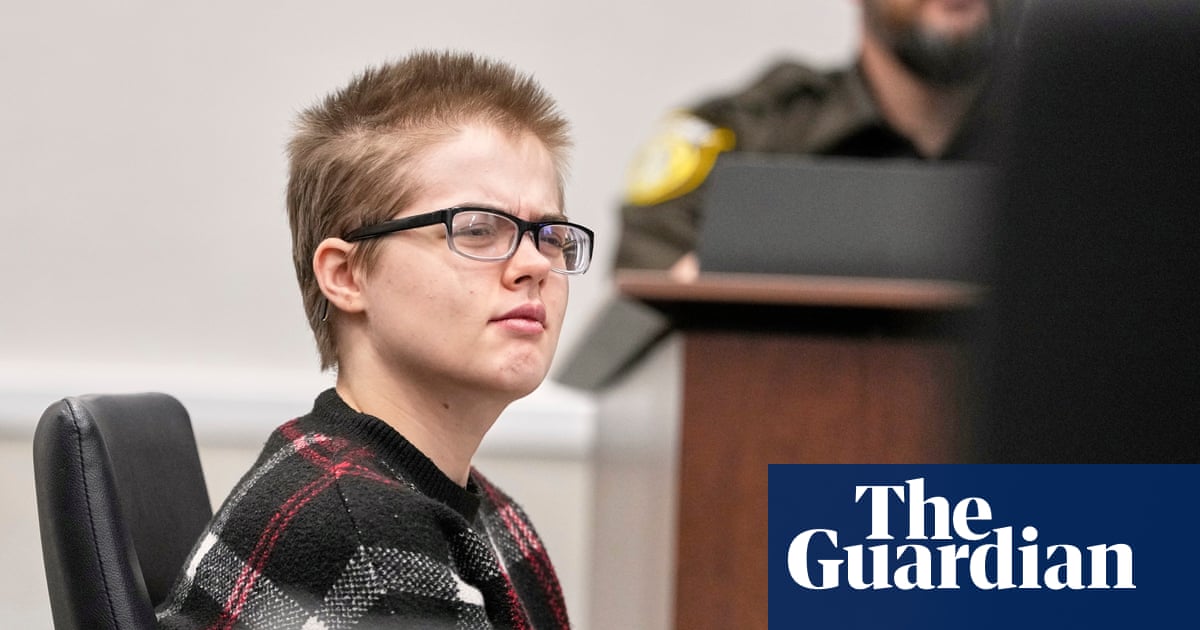
The haunting apparition of “Slender Man” reappeared last week when Morgan Geyser, a central character in an 11-year-old attempted murder case, briefly absconded from a Wisconsin care home to which she had been transferred after being released from a psychiatric institution over the summer.
Geyser was 12 in 2014 when she pleaded guilty to stabbing a sixth-grade classmate to appease the mythical Slender Man.
Geyser, now 23, was picked up 24 hours later 100 miles away at a truck stop outside Chicago in the company of 43-year-old Chad “Charley” Mecca, a transgender woman. She had cut off her monitoring ankle bracelet. Mecca said in a phone call to the Wisconsin news outlet WKOW, “she ran because of me.” It later transpired that Mecca and Geyser feared they would no longer be able to visit each other and were potentially trying to make it to Nashville, Tennessee, when they were stopped by police.
Now Geyser faces being returned to the psychiatric institution to which she was sentenced after pleading guilty to stabbing Leutner with a kitchen knife, allegedly at the behest of another schoolfriend, Anissa Weier, and all in service of appeasing the fictional horror character Slender Man.
The story of the three pre-teen girls and Slender Man has never really gone away. Its reappearance, like the fictional character itself, as a contemporary myth within societal fears can be loaded: headlines and documentaries have dwelt on the dangers of outside intrusion on young minds and the failures of the mental health and criminal justice systems and parenting.
“Whatever people feel about the original crime, it’s important to understand that Morgan’s incarceration began at age 12. What we’re seeing now says less about who she was then than about how she developed inside the system,” says Kathleen Hale, author of Slenderman: Online Obsession, Mental Illness, and the Violent Crime of Two Midwestern Girls, who has written on the case since 2014.
Both Geyser and Weier were prosecuted as adults under Wisconsin law and a jury found them not guilty by reason of mental defect or disease. Weier was sentenced in 2017 to 25 years in a mental institution and granted supervised release four years ago; Geyser was sentenced to 40 years in an institution.
The jury accepted she was suffering from undiagnosed schizophrenia at the time of the stabbing, and she was additionally diagnosed with autism and post-traumatic stress disorder (PTSD).
“She entered the system as a child and never had the chance to grow up inside it,” Hale says. “This is a 23-year-old woman whose emotional and educational development effectively froze at age 12.”
The young woman we are looking at, she says, who now faces being returned to a psychiatric institution, has been failed by the system both as a child and now as an adult.
“She spent her adolescence in forensic wards with violent adults, not in school classrooms. She wasn’t rehabilitated – she was institutionalized. Morgan is a person with autism who never received the education or therapy needed to develop basic skills like social reasoning and long-term planning.”
In effect, she says, prosecuting children as adults merely creates damaged adults. “There is decades of research showing that trying children as adults produces worse outcomes, not better ones. This isn’t about leniency – it’s about what actually prevents harm to the community. You can punish a child, or you can build a future adult – you can’t do both.”
According to reports from the time, Leutner had gone to Geyser’s home for a slumber party to celebrate her birthday. The next day, Geyser and Weier were at a computer when Leutner joined them for doughnuts. They went to a park in Waukesha, Wisconsin, to play hide-and-seek where Geyser stabbed Leutner 19 times with a kitchen knife while Weier looked on.
Leutner was left in the park and eventually crawled out of the woods and was found by a passing cyclist. Meanwhile Geyser and Weier tried to reach a distant forest where, they hoped, they would meet Slender Man who would take them to live with him in Slender Mansion.
When the crime made the news and in the following trial, the fictional character, a thin, unnaturally tall humanoid figure that originated as a creepypasta internet meme created by a Something Awful forum user, Eric Knudsen, in 2009, had in effect taken human form and become a figure in the trial.
This “should be a wake-up call for all parents”, said the Waukesha police chief. “The internet is full of dark and wicked things.”
Geyser disclosed lifelong visual and auditory hallucinations that included figures she interpreted as ghosts, colors melting down walls and imaginary friends. Her mother described her as being “floridly psychotic”.
When a judge ordered that Geyser could be released from the Winnebago mental health institute this year, prosecutors attempted to block the move, arguing that she had read Rent Boy, a novel about murder and selling organs on the black market, and communicated with a man who collects memorabilia from murderers.
“The state has real concerns these things are, frankly, just red flags at this point,” said Abbey Nickolie, the Waukesha county prosecutor. But Geyser’s attorney Tony Cotton described the prosecutor’s request to keep her in a psychiatric hospital as a “hit job”.
Geyser was conditionally released from the psychiatric facility to the group home. She reportedly met Mecca at church two months ago. After the pair were detained in Illinois on Sunday night, Mecca told told WKOW that she believed leaving Wisconsin with Geyser was the best way to keep Geyser safe.
Mecca told the television station that the younger woman didn’t like her group home and claimed she was being mistreated. They had met at a parking lot where Geyser expressed a desire to escape.
“She sobbed – she’s like, ‘They’ll take away our visitation. Charly, please … you’re my best friend. And you know, you know that before you showed up, I was ready to drink bleach’ and just all this stuff,” Mecca told WKOW.
According to Hale, Geyser’s flight from the group home is not evidence of dangerousness but evidence of desperation. “For someone institutionalised since childhood, freedom isn’t just a reward – it’s frightening,” she says. “It’s not hard to see why someone raised inside locked institutions might not trust that release would really happen.”
Hale argues that Geyser’s escape “should not be treated as an extension of the original crime”.
Hale argues that if state authorities continue to prosecute children as adults, crazy things like this will continue to happen. “The state didn’t just punish Morgan – it failed to raise her. Wisconsin took a child and created an adult with no tools for adulthood. We can hold two truths: the crime was terrible, and the response failed.”