- What’s the Monarchy For? begin on BBC One and iPlayer on Tuesday at 9pm
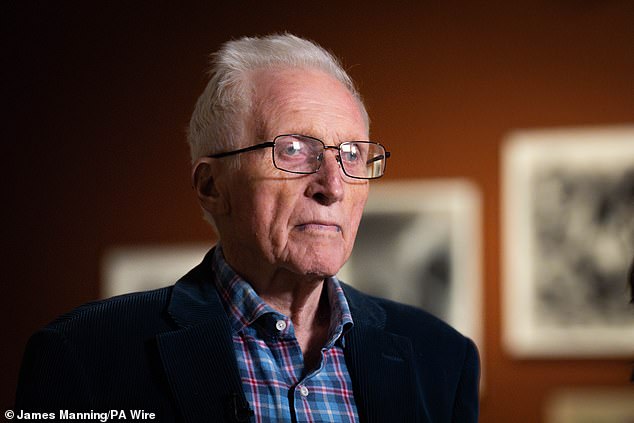
Prince William is trying to save the monarchy by looking look like an ‘ordinary Joe’, David Dimbleby has said.
The veteran broadcaster, 87, believes the future king and his wife are working hard to halt the fall in popularity of the monarchy by appealing to young people who view the institution as old fashioned.
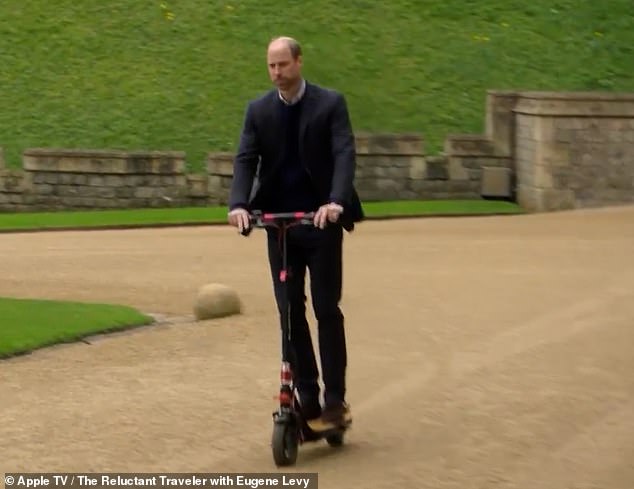
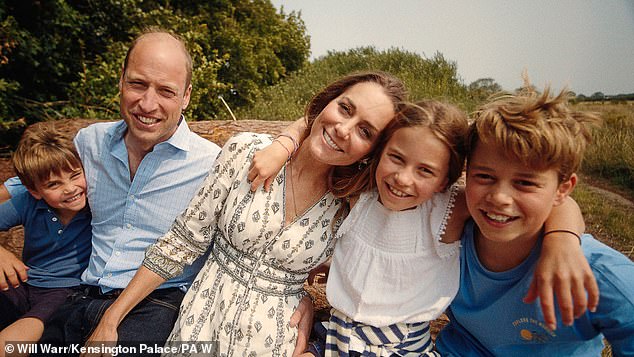
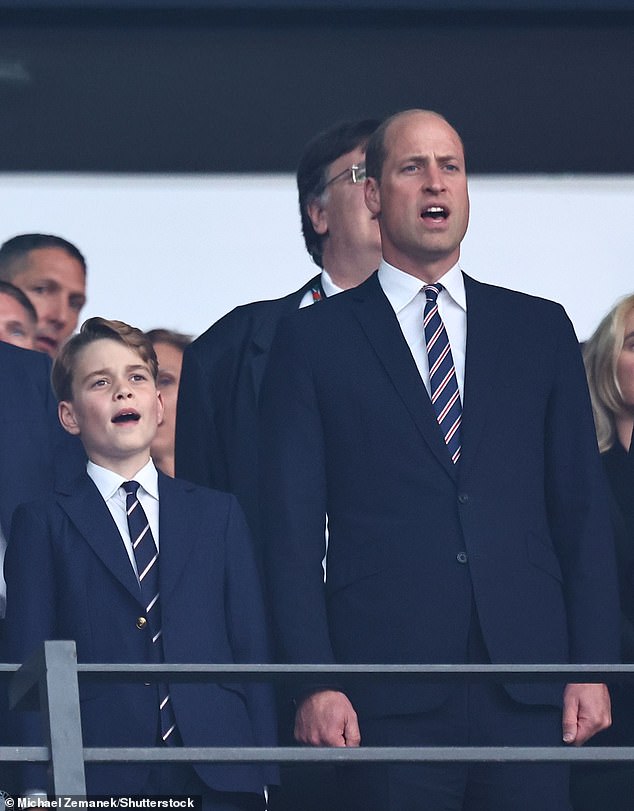
Mr Dimbleby cited William zipping around Windsor Castle on an e-scooter, Kate’s moving videos during her battle with cancer and their ‘off duty’ social media posts of their young family as means of positively connecting with the public.
‘It seems to be resonating’, he said.
The 87-year-old, whose brother Jonathan Dimbleby is a close friend of King Charles, believes that the Prince and Princess of Wales are succeeding in keeping the royal brand positive because they are consistently the most popular British royals.
Mr Dimbleby pointed to William’s interview with actor and comedian Eugene Levy, where he turned up on an e-scooter.
‘A bright idea – the image getting across is that William is just an ordinary Joe’, he wrote on the BBC website ahead of the broadcast of his documentary series called What’s The Monarchy For?.
He went on: ‘The social media posts that Prince William and his family share to their 17.1 million followers have a similar approach, with many showing them off-duty, with videos shot in woods, on sand dunes. One shows the Princess of Wales sharing her relief at having finished chemotherapy treatment, and reflecting on the importance “of simply loving and being loved”.’
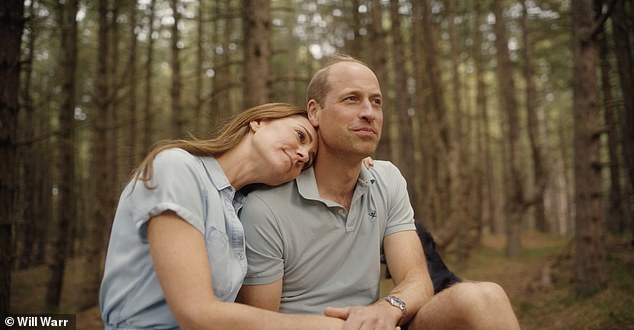
Mr Dimbleby says that the approach is paying off for the Prince and Princess of Wales.
‘Prince William and Catherine have public approval ratings of 76% and 73% respectively – higher than all other family members in last month’s YouGov survey‘, he said.
But he warned: ‘No matter what changes Prince William makes – nor Prince George after him – the bigger question of what becomes of the monarchy in the distant future may not be theirs to decide’.
Ahead of the release of his three-part BBC series on the royals, which begins on Tuesday night, Mr Dimbleby says public approval of the monarchy is in wider decline and can be traced back to the death of Princess Diana.
‘I suspect the real challenge facing the Royal Family is the fundamental question of what it stands for in the modern world – a world radically different to the one Elizabeth II reigned over when she ascended the throne in 1952‘.
Experts have also told him in his new BBC show that William may tone down his own coronation because ‘dressing up in all the stuff’ doesn’t appeal to him.
But the 87-year-old has claimed that scandal surrounding the former Duke of York and the unpopularity of Prince Harry and Meghan Markle are not to blame for the wider fall in support for the royals.
‘This institution can recover from disapproval’, Dimbleby said.
But the 87-year-old has claimed that scandal surrounding the former Duke of York and the unpopularity of Prince Harry and Meghan Markle are not to blame for the decline wider in public approval of the monarchy.
He wrote: ‘In 1983, 86% of people said it was “very important” or “quite important”. In last year’s survey, just 51% of people answered the same.
‘Plenty of people might be quick to put the most recent threat to those bonds down to scandal. There is no love lost between Andrew Mountbatten-Windsor, as he is now known, and the British public.
‘Only 4% of people had a “positive” view of him in a YouGov poll in October (the same month he was stripped of his titles), followed by the Duke and Duchess of Sussex, with ratings of 30% and 21% respectively.
‘Yet no-one I spoke to while making these films pointed to any one individual as the sole reason for the current standing of the monarchy in the eyes of the public’.
Prince William has made clear he will not be afraid to make difficult decisions as king, declaring: ‘Change is on my agenda’.
He told Eugene Levy in October that he won’t be ‘overly radical’ but he does also want to ‘own’ the role – and reform of the institution is likely to be at the top of his in-tray.
‘I think it’s safe to say that change is on my agenda. Change for good. And I embrace that and I enjoy that change – I don’t fear it,’ he said.
But David Dimbleby said: ‘The monarchy’s existence thrives on the “oxygen of public support”, so it is the public themselves who will decide through that support whether having this kind of head of state continues to suit us as a country’.
Mr Dimbleby has spoken to experts and academics about the future of the monarchy.
They said that declining support for the institution ‘marks a problem’ for William and his father King Charles.
Anna Whitelock, a professor of the history of monarchy at City, University of London, said: ‘The only way the monarchy works is by everybody either being apathetic or feeling very affectionate towards it.
‘If those bonds are broken, there really is no purpose or point of monarchy.
‘The Royal family is a brand. There is always a sense of needing to keep the brand popular’.
She added: ‘If the monarchy is really to modernise in a significant way, we need to see much more transparency, much more accountability’.
After ten general elections and presenting Question Time for 25 years, he went into semi-retirement.
But when Queen Elizabeth II died he returned to work.
He claimed that the royals were trying to control what the public saw during Her Majesty’s funeral.
He said: ‘In September 2022, I was at Windsor to report on the final stages of Elizabeth II’s funeral. The Palace issued instructions to the broadcasters about scenes that, once shown live, should never be shown again.
‘A number were quite small things, for example, the crown being handled, somebody looking visibly upset, Prince George touching his nose, the Duke and Duchess of Edinburgh’s handkerchiefs, and, at the lying in state, shots of the Royal Family mouthing the Lord’s Prayer.
‘These little excisions from reality – or “perpetuity edits,” a kind of George Orwell speak – see them remove from the world anything they don’t like.
‘On the one hand, they have the right to grieve in private; on the other, the late queen was our head of state and this is her public funeral. Do we have a right to see it all or do they have the right to control what we see?’
It came as Mr Dimbleby, 87, singled out for criticism the King’s decision in February to invite Keir Starmer and Angela Rayner to a housing development in Cornwall.
He said it proved that the King, who as Prince of Wales lobbied ministers on the environment, defence and architecture, was continuing to meddle in politics.
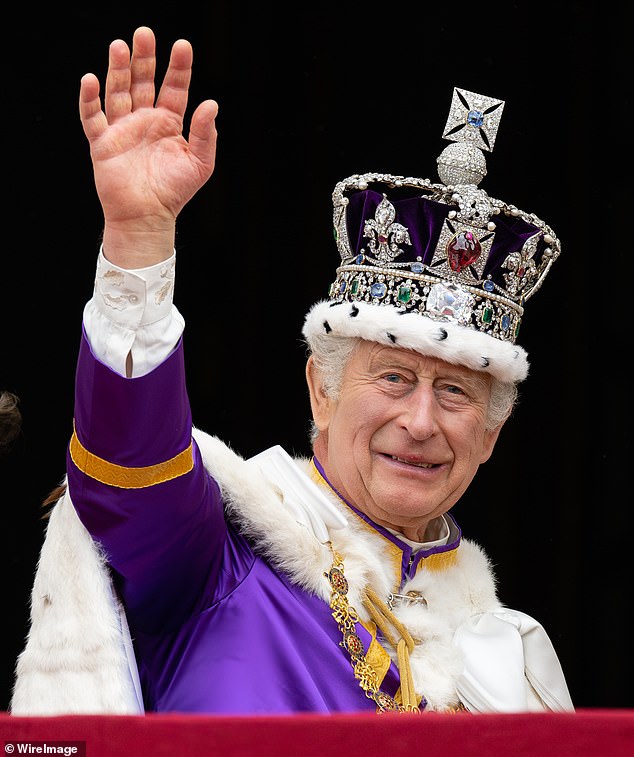
Mr Dimbleby says the visit was a clear attempt by the King to influence future housing policy.
He told The Mail on Sunday: ‘The fact that he took the Prime Minister down to Cornwall to say, “This is the kind of housing I think we should be building”, is interesting because that actually isn’t the monarch’s role.
‘We are a democracy and it’s not his business to start telling prime ministers or indeed us how things should be. I think that is not the role of the head of state.’
As Prince of Wales, Charles lobbied ministers extensively, primarily through private correspondence dubbed ‘black spider memos’ because of his distinctive handwriting.
He argued for the adoption of complementary medicines in the NHS, backed a badger cull and intervened in planning disputes to save historic buildings.
But he said in a BBC TV interview in 2018 that he knew he could not meddle in the same way when he was King.