A teenage girl who was allegedly tied up and thrown into a swamp to drown in an honour killing had infuriated her strict father by refusing to wear an Islamic headscarf and by using social media, Dutch prosecutors have said.
The body of 18-year-old Ryan Al Najjar was found gagged, her hands tied behind her back and her ankles taped together, dumped in a swamp six days after she vanished from the family home in Joure in May last year.
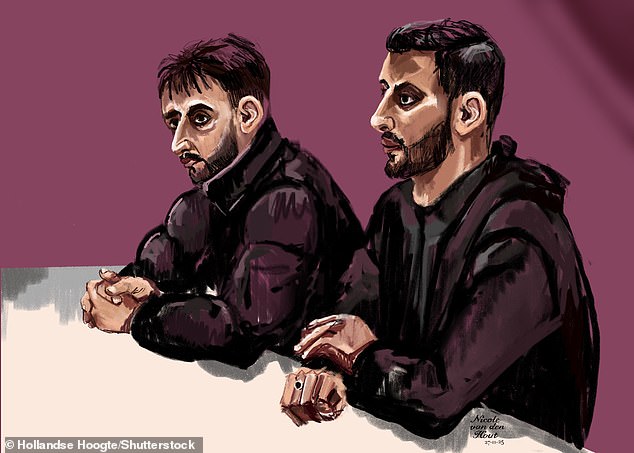
Her brothers, Mohamed, 23, and Muhanad Al Najjar, 25, are now on trial for her murder, while their father, Khaled – accused of ordering the killing – has fled back to Syria.
Prosecutors say Ryan had violated her family’s strict expectations by adopting a Western lifestyle, mixing with boys, refusing to wear a headscarf, and using social media.
‘The immediate cause of her death appears to be a live video on TikTok, showing Ryan without a headscarf and wearing makeup,’ prosecutors told the court on Friday.
‘The video seriously embarrasses the family, according to their posts, as it does not fit within their traditional views.’
‘Honor killings are completely unacceptable,’ the prosecutor added, ‘This is a form of femicide.’
Dutch authorities on Friday demanded prison sentences of up to 25 years for the three suspects.

Khaled, the father accused of masterminding the killing,will be tried in absentia after he fled the country.
Investigators allege the murder followed a long pattern of intimidation and control inside the household, with ryan’s behaviour viewed by her relatives as a humiliating betrayal that ultimately led to the fatal attack.
The brothers, whose trial began yesterday, insist they were not involved and say their father carried out the murder alone.
Ryan disappeared on May 22, 2024. A passerby discovered her body on May 28 in Lelystad, about 25 miles north-east of Amsterdam.
Investigators later found DNA belonging to her father under her fingernails, indicating that she had put up a fight.
Khaled allegedly sent two emails to Dutch newspaper De Telegraaf claiming responsibility and saying his sons were innocent. Prosecutors, however, rejected that claim.
They argue that the father told his sons to collect Ryan, drive her to an isolated location, and meet him there.
Shortly after midnight, Ryan was killed.
In court, the prosecutor described the fear Ryan must have felt – alone in the dark and far from help.

‘What must she have feared,’ the prosecutor said. ‘In the middle of the night, in complete darkness, in a completely isolated place.’
The prosecution says the brothers carried out the plan knowing she would die.
Forensic investigations confirmed all three suspects were present at the crime scene, although it is unclear who performed specific acts. ‘Khaled was the driving force, but without his sons, Ryan would not have been there at all,’ prosecutors said.
While the brothers blame their father for the murder, their sisters support them and also hold the father responsible.
Prosecutors, however, pointed to intercepted chat messages suggesting the brothers may have been actively involved.
Khaled reportedly sent emails to Dutch media confessing to his daughter’s murder while claiming his sons were not involved.
Before her death, Ryan was being monitored by the police and was given protection, but that was ended prior to her murder. It has not been disclosed why the protection was withdrawn.
Both brothers were arrested shortly after the body was located and have remained in custody since then. Defense lawyers are scheduled to present arguments Monday. The court will issue its verdict on January 5.
Their father fled the country and has not been tracked down.
According to the Dutch current-affairs programme Nieuwsuur, Khaled is believed to be living in northern Syria and has remarried since the killing.
The Dutch Ministry of Justice and Security told the programme that the Netherlands currently has no way to secure his return.
‘The possibilities for criminal cooperation with Syria are currently not available,’ the Ministry said. ‘The criminal justice authorities required for this cooperation are not [yet] operational in Syria.’
However, Syria’s own Ministry of Justice has disputed that assertion. Minister Mazhar al-Wais said the system had been rebuilt and was functioning.
‘That may have been the case in the beginning when the regime had just fallen. Now the Syrian justice system has been fully restored,’ he said.
He said the country was ‘ready’, adding that Syria has already received three legal-assistance requests from European nations.
‘We will provide the necessary legal assistance in accordance with the regulations.’
The Syrian minister also said his government had never received a request from the Netherlands regarding this case.
The brothers’ lawyers had earlier requested that they be released from pre-trial custody. But a judge ruled that they must be held behind bars until their trial.