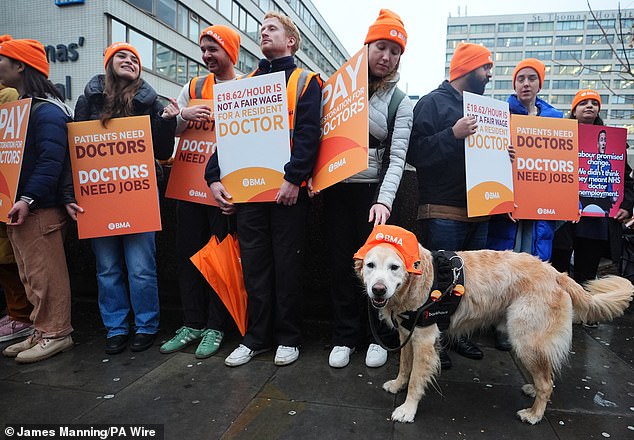
Resident doctors will strike again this month for five days of industrial action, designed to bring hospitals to a standstill.
Thousands of medics — previously known as junior doctors — will walk out from December 17 to December 22.
British Medical Association (BMA) bosses claimed they had ‘no choice but to announce more strike dates’ after the Government failed to put forward a ‘credible plan’.
The medics have already taken industrial action 13 times since 2022 — with their last walkout just two weeks ago — crippling services and forcing health bosses to cancel an estimated 1.5million appointments.
They were offered a 5.4 per cent pay rise in May following a review of public sector pay.
The increase, recommended by an independent pay review body, was above the rate of inflation, which jumped to 3.5 per cent in April, the highest since January 2024.
But union leaders labelled the uplift an ‘insult to doctors’ and said a pay lift of 29.2 per cent was vital to reverse ‘pay erosion’ since 2008.
The BMA has also warned doctors are struggling to find jobs at a key stage of their training — between years two and three when they start speciality training.
This year there were more than 30,000 applicants for 10,000 jobs at this stage, although some will have been doctors from abroad.
Dr Jack Fletcher, chair of the BMA’s resident doctors committee (RDC), said: ‘With the Government failing to put forward a credible plan to fix the jobs crisis for resident doctors at the same time as pushing a real terms pay cut for them, we have no choice but to announce more strike dates.
‘However, these do not need to go ahead.
‘Gradually raising pay over a few years and some common-sense fixes to the job security of our doctors are well within the reach of this Government.
‘It would ensure both the long-term strength of our healthcare workforce and spare the country the indignity of see unemployed doctors at a time patients are queuing up to even even see a GP.
‘This month we’ve seen the full farcical extent of the jobs crisis, with second-year doctors applying for training posts being asked to provide evidence of experience well beyond what would have previously been asked of them.
‘It is precisely this sort of situation which is driving doctors away from jobs and to the picket line. But it is not too late for Government to get a grip on the situation.’
Resident doctors make up around half of all doctors in the NHS.
During their first foundation year after finishing their medical degree, resident doctors in England earn a basic salary of £38,831. In their second year, this rises to £44,439.
Medics are often expected to work night shifts, weekends and longer hours for extra payments.
After eight years or more as a resident doctor, salaries can progress to around £70,000.
The BMA claimed first year resident doctor pay is 21 per cent lower in real terms than it was in 2008.
It wants pay for the group to be brought back in line with the level it was at 17 years ago, when they say their value of their pay started to be eroded.
The claim is based on a measure of inflation called the Retail Price Index (RPI) — this includes housing costs and shows higher price increases than some other inflation measures.
However, the Government says RPI is outdated.
Instead, it uses the Consumer Prices Index (CPI) to calculate inflation and pay increases.
CPI looks at the cost of goods and services based on a basket of household items.
Using the CPI measure, the government says resident doctors’ current pay is fair.
Analysis from health think tank the Nuffield Trust has suggested that pay has fallen 5 per cent since 2008 if CPI is used.
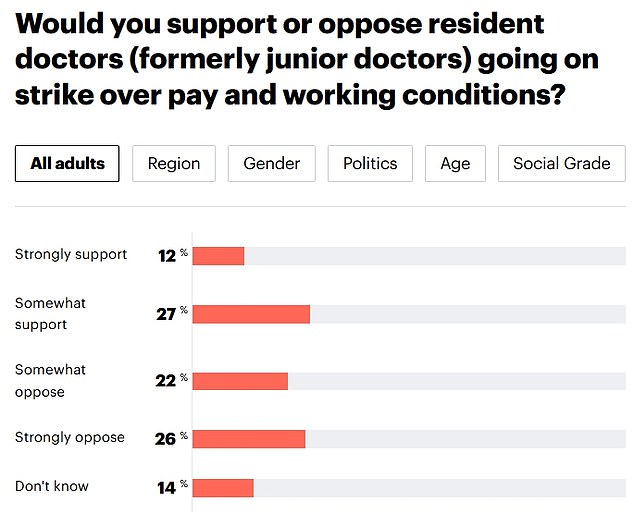
Earlier this year, a YouGov poll also found that 48 per cent of Britons oppose resident doctors going on strike, while 39 per cent support them taking action.
YouGov said this ‘marks a shift in opinion’ of public support of striking junior doctors last summer, when the majority of Britons — 52 per cent — said they supported the action.