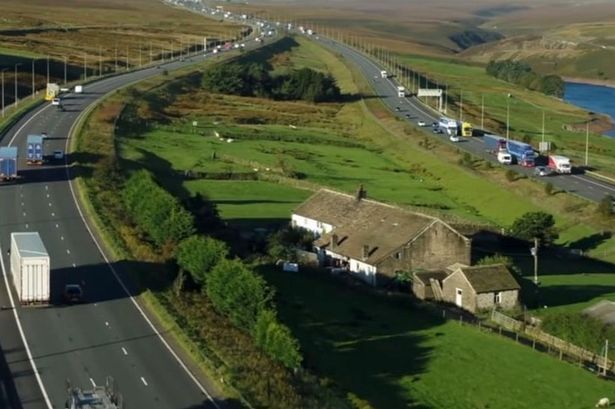
Stott Hall Farm in Yorkshire is one of the most famous homes in England, an 18th-century farmhouse built splat bang in the middle of a busy motorway. The stuff of urban legend, an unearthed documentary reveals the truth behind the iconic “Little House on the Prairie”.
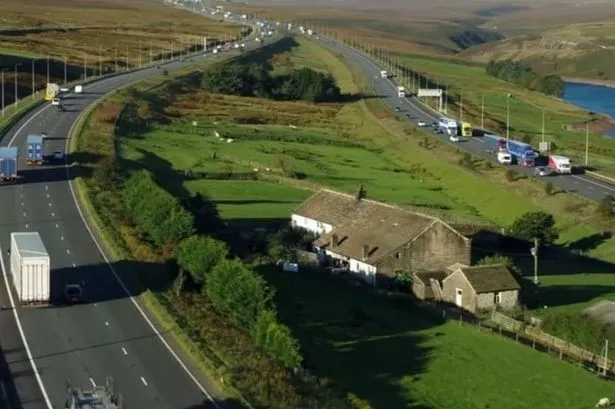
Drive up the M62 toward Leeds and you’ll notice an iconic quirk in the middle of road – an 18th-century farmhouse, surrounded by sheep grazing obliviously on the grass and built in a fork in the middle of the motorway.
Stott Hall Farm in West Yorkshire, affectionately nicknamed the “Little House on the Prairie”, is the stuff of urban legend. People say that the bizarre landmark was born when resident farmer, Ken Wild, refused to sell his land after motorway developers came knocking in the 1960s. Unable to convince Ken and his wife, Beth, off their land, the developers are said to have decided to simply go around them, encircling the farm between snaking asphalt, three heaving lanes at either side.
The truth, though, is far simpler. In 1983, Michael Clegg, a Yorkshire journalist who had grown curious about the property, went down to Stott Hall to interview Ken and Beth for the BBC. The couple told Clegg they had been living on the land since 1934, although people have been farming it since 1737. And the reason why they never left? Well, it wasn’t their choice at all. The house wasn’t even owned by them at the time – it was owned by Yorkshire Water.
As Michael explained: “A geological fault beneath the farmhouse meant it was more practical for engineers to [go around] it rather than blast through [the farm] and destroy it.” In other words, the developers had discovered the land below the farm wouldn’t be able to bear the weight of the motorway and the 90,000 cars that drive over it every day. This happy coincidence spared Stott Hall from certain demolition.
Ken said: “It looked like we would have to move, but they found out they couldn’t get all six lanes together.” The couple confirmed that they still lost about 70 acres of farmland to the construction. But, overall, they didn’t mind. He added: “Outside the noise is relentless but inside it’s as peaceful and cosy as any farmhouse.”
But the unconventional new spot did come with a fair share of side effects. Early one morning, around 4:20am, the couple heard a deafening crash outside their home. By that point no strangers to loud sounds, the bang nevertheless drew them outside, where they found a 32-ft, multi-tonne lorry overturned in their yard. Beth said: “The driver climbed out through the windscreen. He wasn’t hurt at all.”
In 2009, the couple sold the iconic farm to Jill and Phil Thorp. The Thorp’s renovated the home and lived there with their son, John-William. Tragically, Ken has passed away in the years since. Speaking to the Manchester Evening News, Jill said: “Traffic is very close. But it’s always windy here, which takes the pollution away. Students from the University of Huddersfield took soil and air samples and actually pollution is surprisingly low.” Although Jill said while she was still “sensitive” to all the noise, she wouldn’t have it any other way.
“A lot of people say it’s bleak and like Wuthering Heights but I don’t see it like that. I think it’s beautiful.” The M62 is a 172km stretch of motorway in the North of England, connecting Liverpool and Hull via Manchester, Bradford and Leeds. Opened in 1960 and completed in 1976, it is nicknamed “the UK’s highest motorway” because, between Manchester and Leeds, it cuts through the Pennine Hills, climbing to heights of 1,221ft above sea level.
When the Queen opened the section of the motorway in 1971, she had to wear a hat made especially so that it wouldn’t blow away in the wind. Stott Hall Farm can be found between junctions 22 and 23 on the motorway.