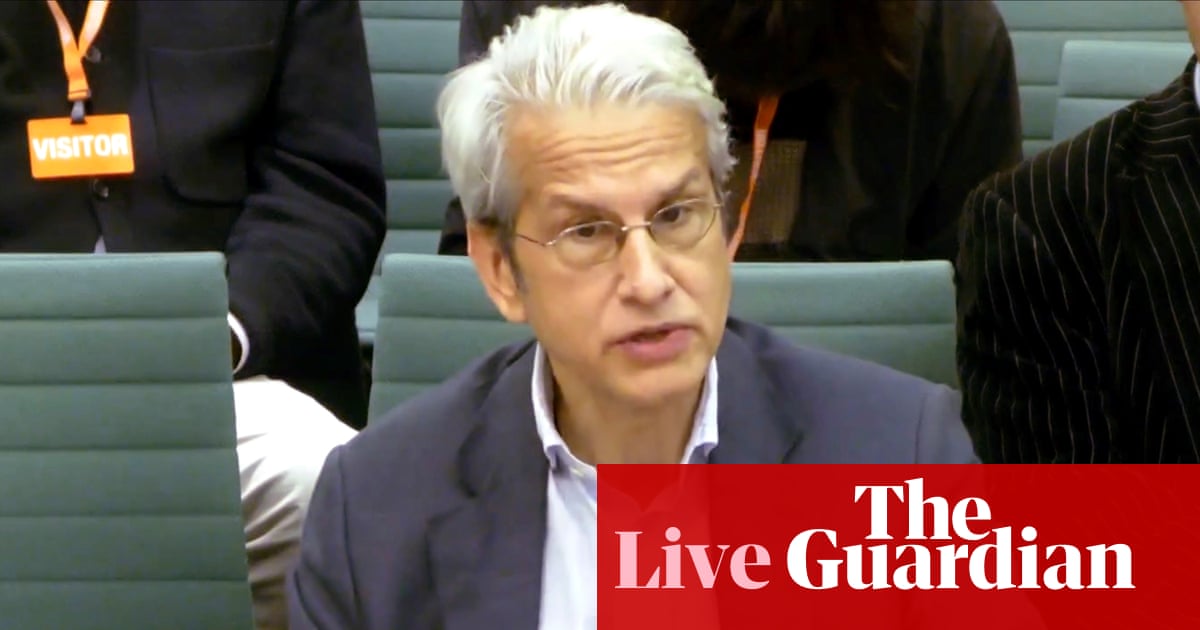
The committee asks Prescott whether he thinks the BBC is institutionally biased?
“I don’t,” says Prescott. “Let’s be very clear. Tons of stuff the BBC does is world class factual programming… I think the standard of BBC Westminster is exemplary, and that’s why I keep saying these were incipient problems. We were finding the odd problem here and there.”
He says the crucial thing was that when problems were spotted, they appeared to have systemic causes that were not addressed.
He says “the root of his disagreement and slight concern even today” was that the BBC appeared to not be treating the problems as having systemic causes.
“There’s real work that needs to be done at the BBC.”
Caroline Daniel is also asked about her views on editorial bias.
“My experience was the BBC took issues of impartiality extremely seriously,” she said.
She says in her three years involved on the standards committee, it was a “continuous process, an active debate” on issues on individual daily programmes, “across thousands of hours of coverage”.
She said there was always healthy debate, and the BBC was always open to discussing if the right line had been taken.
“Was the BBC willing to have a proper conversation, debate and actually take action? In my view, yes.”
The committee asks Prescott whether he thinks the BBC is institutionally biased?
“I don’t,” says Prescott. “Let’s be very clear. Tons of stuff the BBC does is world class factual programming… I think the standard of BBC Westminster is exemplary, and that’s why I keep saying these were incipient problems. We were finding the odd problem here and there.”
He says the crucial thing was that when problems were spotted, they appeared to have systemic causes that were not addressed.
He says “the root of his disagreement and slight concern even today” was that the BBC appeared to not be treating the problems as having systemic causes.
“There’s real work that needs to be done at the BBC.”
Prescott is the first to respond, acknowledging “the saga does begin with that memo that I wrote”, which he says he wrote because “let me be clear, because I am a strong supporter of the BBC.”
What troubled me was that during my three years on the BBC’s standards committee, we kept seeing incipient problems, which I thought were not being tackled properly. And indeed, I thought the problems were getting worse.
He says in the era of fake news, the BBC can become the provider of news for the entire world.
“I would like it to happen, but it can only happen successfully if the BBC, I think, does a better job addressing these incipient and growing problems of the type that the Standards Committee kept identifying. And that’s why I tried to alert the BBC board to what was going on. And indeed thereafter sent a memo on to Ofcom and DCMs. There was no ideology at play here, no party politics.”
The Select Committee has begun their questioning.
Michael Prescott and Caroline Daniel, the external advisers to the editorial and standards committee, will be the first to face quizzing from lawmakers.
Many people will be closely watching today’s proceedings to understand what went on at the BBC board level. Some key questions from the Guardian’s media editor Michael Savage:
After his role as external adviser ended over the summer, Prescott sent his memo to the BBC board in September. He said he was doing so because his concerns of bias had been ignored.The BBC has apologised for an edit of a Trump speech raised in the memo, but Shah has also claimed Prescott’s memo was a partial and personal account.So how many issues that Prescott outlined have not been dealt with? Daniel may have a view on whether Prescott is right to say he was ignored.
Some in the BBC believe that while Prescott’s memo pointed to real failings, it was part of a longer-running attempt by like-minded figures to pressure the corporation from the right. They point to the fact that many of Prescott’s concerns chimed with those of Gibb. Prescott’s memo was based on research carried out by David Grossman, a longstanding journalist who had once confronted a colleague over bias. Who suggested what Grossman should be researching? Was there a pre-existing relationship between Gibb and Prescott?
In response to the crisis, the BBC is preparing several new measures, my colleague Michael Savage has been reporting:
The BBC is planning to overhaul the way it investigates editorial concerns, in a move that will dilute the influence of a Conservative figure accused of trying to sway its political impartiality.
A new deputy director general post is also expected to be created to aid Tim Davie’s successor as director general, after concerns that the task of overseeing the corporation has become too big for one person.
The measures are being prepared as the BBC reacts to a crisis that led to the sudden resignations of Davie and Deborah Turness, the head of BBC News.
Shumeet Banerji resigned from the board on Friday after saying he was cut out of the discussions that led to the shock resignation of director general Tim Davie.
The tech industry executive was out of the country on the crucial days before the departure of Davie and the head of BBC News, Deborah Turness.
The pair quit after tense board discussions over how to respond to allegations of liberal bias made by Michael Prescott, a former independent external adviser to the BBC’s editorial guidelines and standards committee (EGSC). Prescott left that role in the summer.
Banerji cited what he called “governance issues” at the top of the corporation.
In a letter, he said he had not been consulted about the events leading up to the departures of Davie and Turness.
Michael Prescott: The former editorial adviser on the editorial guidelines and standards panel, whose memo raising concerns about an edit of a Donald Trump speech was leaked to the Telegraph newspaper in early November, prompting questions over editorial standards.
The Guardian understands that conflict among the board in responding to the memo is what led to the resignations of Davie and Turness. Prescott has not issued any public statement yet. This will be the first time we hear from him.
Robbie Gibb: A board member appointed under the former Conservative government, who is also a member of this pivotal Editorial Guidelines and Standards Committee (EGSC). Since the resignations, several politicians and a staff union have called for his removal from the board, alleging he wielded improper political influence.
Samir Shah: The BBC Chair has been under pressure for the board’s delayed response to the editorial issues of the Panorama edit. He has denied any improper political interference on the board as a “fanciful” notion.
Caroline Thomson: A long-term board member and former Chief Operating Officer, who had served for 12 years as a member of the BBC’s Executive Committee.
Caroline Daniel: A former editorial adviser who was in the role alongside Prescott.
The BBC has been in crisis since the sudden resignation of its director general, Tim Davie, and the head of news, Deborah Turness.
Their decision shocked many in New Broadcasting House, but what emerged in the hours after their departure was talk of a rightwing “coup”, board splits and crippling delays.
Their departure followed a disagreement over how to respond to a memo from a former external adviser Michael Prescott, in which he claimed there were “serious and systemic problems” at the corporation.
Prescott alleged liberal bias in its coverage of the US election, Gaza and racial diversity and transgender issues.
MPs on the culture, media and sport committee are examining Prescott’s claims this afternoon. They will hear from Prescott and Robbie Gibb, the Conservative-supporting BBC board member accused of raising repeated claims of liberal bias.
Also appearing are Samir Shah, the BBC chair, Caroline Daniel, who was an external adviser alongside Prescott, and Caroline Thomson, another BBC board member.
Hello and welcome to our live coverage of a parliamentary committee’s questioning of key BBC figures involved in the broadcaster’s editorial standards crisis.
The BBC is facing a potential billion-dollar lawsuit from the US president, Donald Trump, over a misleading edit of his January 6 speech in a BBC documentary.
Disputes over how the broadcaster might respond to that error led to the shock resignations of both its director general and head of news earlier this month.
The BBC’s chair as well as other key figures in the row are due to be questioned over their actions, at a hearing this afternoon in the House of Common’s culture, media and sport committee.