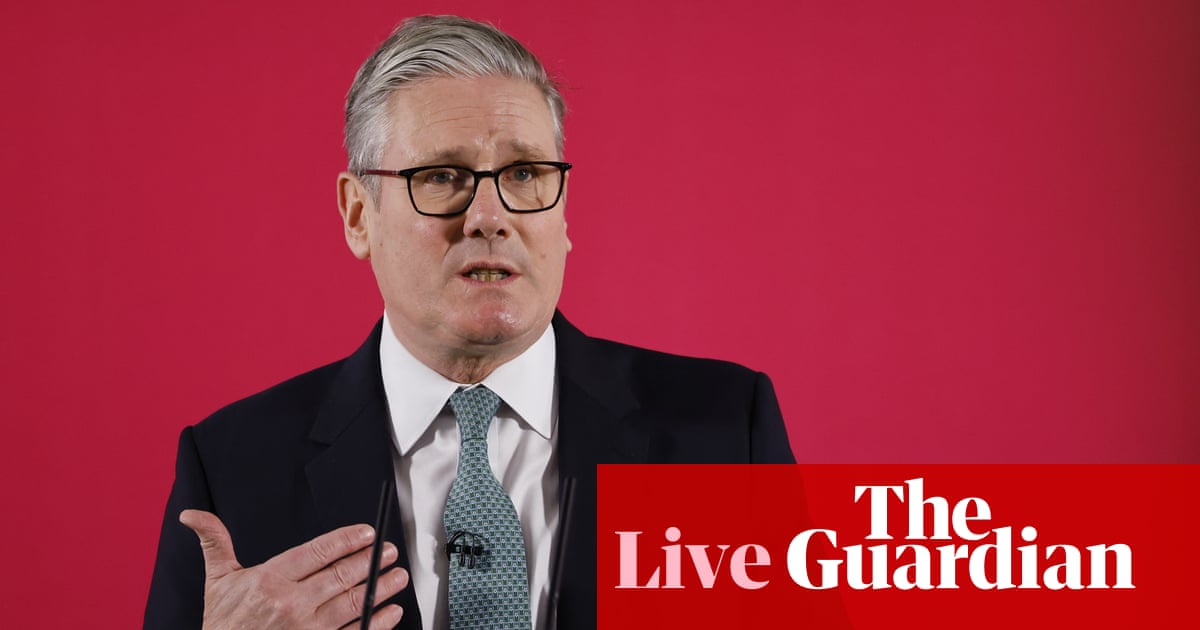
Keir Starmer is speaking now.
He says he remembers when he was growing up his family having the phone cut off because they could not pay the bill. So he is proud the budget took steps to cut child poverty, he says.
[Not being able to pay bills] is still the reality of Britain for far too many people.
So yes, I am proud. I’m proud we scrapped the two-child limit. I’m proud of lifting over half a million children out of poverty. Proud we raised the national minimum wage again. That is what a Labour government is for – making life better for working families.
Starmer is now taking questions.
Q: [From the BBC’s Chris Mason] Was Rachel Reeves open about the state of the economy? And do you want welfare spending to fall?
Starmer says the productivity downgrade meant the Treasury needed to raise £16bn more than it would have done without that.
He says the government was always going to have to raise extra money.
At one point he thought they would have to breach the manifesto promise on tax.
He asks if there were alternatives. There were alternatives, and that did not need to happen.
On welfare, Starmer says is particularly concerned about young people who are not earning or learning. He says there a moral element to this.
Starmer then mentions the need for welfare reform. (See 9.28am.)
And he ends by saying it is necessary to admit that the Brexit trade deal has harmed the economy. He calls for closer economic ties with the EU.
Starmer says he wants to use the rest of his speech to talk about the next steps for economic renewal.
First, he turns to regulation – and mentions the report from the nuclear regulatory taskforce last week.
That mentioned “pointless gold plating, unnecessary red tape, well intentioned but fundamentally misguided environmental regulations” and said Britain awas the most expensive place in the world to build nuclear power.
He says he wants the government to cut this sort of regulation.
Starmer says the measures in the budget are not just about helping people with the cost of living; they are about giving people security too, he says.
On growth, he says:
When it comes to economic growth, better living standards, we’re confident we can beat the forecasts. We’ve already beaten them this year.
We are in control of our future. We’ve already struck trade deals. They’re attracting billions of pounds of investment. We’re removing barriers to business right across the economy in planning, industrial policy, pension reform, artificial intelligence, capital investment and right at the heart of the budget we have a package of measures to keep the green light for the world’s best entrepreneurs.
That is why the budget was good for growth, he says.
Starmer says Labour had a difficult inheritance.
But if you’d said to me 17 months ago, on the first day of government, that by now we would have cut NHS waiting times, cut immigration, cut child poverty by a record amount, if you’d said to me that Britain would now be cutting borrowing faster than any other G7 country without cutting public investment, that our fiscal headroom is up significantly, economic growth is beating the forecast, with wages up more since the election than in a decade of the previous government …
If you’d said to me, because of all that, we can tackle the cost of living for working people, freezing rail fares, freezing prescription charges, freezing fuel duty, slashing childcare costs, driving down mortgages, taking £150 off your energy bills, £300 for poorer households – then I would say yes, that is a record to be proud of.
Starmer goes on:
Because we confronted reality, we took control of our future and Britain is now back on track.
But I’m also confident we have now walked through the narrowest part of the tunnel.
Starmer says at the budget the government could have borrowed more, or cut public services.
But those ideas have been “tested to destruction”, he says.
Keir Starmer is speaking now.
He says he remembers when he was growing up his family having the phone cut off because they could not pay the bill. So he is proud the budget took steps to cut child poverty, he says.
[Not being able to pay bills] is still the reality of Britain for far too many people.
So yes, I am proud. I’m proud we scrapped the two-child limit. I’m proud of lifting over half a million children out of poverty. Proud we raised the national minimum wage again. That is what a Labour government is for – making life better for working families.
Q: Reform would review the triple lock. Would you?
Badenoch says the triple lock is Conservative policy. It does cost a lot, she says. But getting rid of it would not help growth, she says. She says you can get rid of it, “and we can all get poorer together”.
She says Reform UK don’t have serious policies.
The real problem with welfare is that not enough people are working, she says.
Q: Yesterday you said Rachel Reeves was lying. Today you are saying she gave out false information. Are you still accusing her of being a liar?
Badenoch replies: “Yes.”
At the Tory event, Kemi Badenoch was asked if she would like to take responsibility for the Conservative’s party role in the productivity downgrade.
Badenoch said there was a problem with public sector productivity when the Tories were in office. She said the problem was associated with Covid. She claimed that her party accepted there was a problem and adopted some “humility”.
Mel Stride, the shadow chancellor, said that the government also put up public sector pay without demanding productivity improvements.
The Office for Budget Responsibility has said that at 2.30pm today it will publish its report on how its budget report was accidentally uploaded to a place on its website where it could be accessed early by journalists on budget day.
Mel Stride, the shadow chancellor, is speaking at the Tory event now. He says the Treasury briefing ahead of the budget deflate the “animal spirits” in the economy, holding back growth.
He claims that the Tory plans to cut spending by £47bn are robust, and have stood the test of time since the party’s conference.
Kemi Badenoch is speaking at an event in London now.
She restates her claim that Rachel Reeves should resign. She claims the chancellor gave people a misleading view of the financial picture because she wanted a “soft landing” for her budget. She said that private company would not be allowed to misrepresent its finances in this way.
Here are two of the most level-headed members of the Westminster commentariat making the point that the Rachel Reeves feeding frenzy (see 9.53am) is getting a bit out of hand.
This is from Heather Stewart, the Guardian’s economics editor (and former political editor) on Bluesky.
This story is starting to make me feel I’m going slightly mad – maybe RR overdid the gloom, but the tax rises are paying for a) the welfare U-turns b) the £10bn-plus increase in headroom c) scrapping the two child limit d) bits of other spending eg higher local gov costs 🤷🏻♀️
And this is from the Economist’s Matthew Holehouse.
It was the most botched budget briefing since Truss… but this is increasingly wild. It is not an unsubstantiated “claim” that the OBR priced the productivity downgrade at £16bn in foregone revenue!
Many of the papers have gone to down this morning on the claims that Rachel Reeves misled the public abouit the state of the public finances ahead of the budget.
Here is the Times’s splash, as referred to earlier. (See 9.28am.)
Here is the Daily Mail and the Daily Telegraph, both highlighting an intervention from Nigel Farage (who has not hitherto been noted for his keen interest in ethical standards in public life).
The Daily Express has led with Kemi Badenoch’s words on this story.
And the Metro is leading with Reeves’s words.
A court in Bangladesh has sentenced the British MP Tulip Siddiq to two years in jail after a judge ruled she was complicit in corrupt land deals with her aunt, the country’s deposed prime minister Sheikh Hasina. Hannah Ellis-Peterson has the story.
Good morning. At Westminster there used to be a theory about budgets that, if they were well received on the day, they tended to go wrong later, but the ones that were widely criticised at the time turned out to be the good ones. This does not help with Rachel Reeves’s budget though, because its reception has been very mixed. On the day it was popular with Labour MPs and with the bond markets, two important audiences for the Treasury. But the public at large believe it was unfair, and it has result in Reeves’s approval ratings with voters, which were already very low, sinking further.
And that was before a huge row erupted over whether or not Reeves misled voters about the extent of the “black hole” in the national finances.
All this means that, when Keir Starmer gives a speech today defending the budget, he will have to respond to Tory claims that she should be sacked for lying – not the best backdrop for a PM trying to sell a budget to the public.
Starmer has given a flavour of what he will say in an article for the Guardian and Kiran Stacey has written it up in our splash story here.
Judging by his article, Starmer will in part be trying recalibrate the budget message by addressing two criticisms that were being levelled at it last week. First, it was pointed out that Reeves said very little in it about promoting growth, even though this is supposedly the government’s top priority. Today Starmer will stress his commitment to deregulation as a pro-growth initiative.
And, second, Reeves was criticised for increasing spending on welfare without combining that with announcements about welfare reform. Today, without giving details, Starmer will insist his commitment to welfare reform is strong. Referring to the need to stop young people getting trapped on sickness or disability benefits, he will say:
We have to confront the reality that our welfare state is trapping people, not just in poverty, but out of work. Young people especially. And that is a poverty of ambition. And so while we will invest in apprenticeships and make sure every young person without a job has a guaranteed offer of training or work.
We must also reform the welfare state itself – that is what renewal demands. Now – this is not about propping up a broken status quo.
No, this is about potential. Because if you are ignored that early in your career. If you’re not given the support you need to overcome your mental health issues, or if you are simply written off because you’re neurodivergent or disabled, then it can trap you in a cycle of worklessness and dependency for decades.
Which costs the country money, is bad for our productivity, but most importantly of all – costs the country opportunity and potential.
This is from an extract from the speech released by No 10 in advance.
But, without specifics, Starmer won’t stop the media asking about the claims that the Treasury’s pre-budget messaging was misleading. According to a story in the Times, even some ministers are saying this in private. The Times story includes this quote.
One cabinet minister said: “Why did Keir and Rachel allow the country to believe for so long that we would break our manifesto by putting up income tax by 2p when they would have known that wasn’t true?
“At no point were the cabinet told about the reality of the OBR forecasts. Had we been told, we might have been in a position to advise against setting hares running on income tax and giving the public the impression we are casual about our manifesto commitments. The handling of this budget has been a disaster from start to finish.”
Darren Jones, the Cabinet Office minister and chief secretary to the PM, has been defending the chancellor in interviews this morning. His line has been the same as Reeves’s yesterday; that she did not mislead anyone about the black hole because, even if though the Treasury did not tell the public that the problems caused by the producivity downgrade (which Reeves did talk about) were offset by higher-than-expected tax revenues (which she did not talk about), she still needed to put up taxes to create proper headroom. The surplus revealed by the OBR on Friday would not have been enough, Reeves and Jones have said.
Here is the agenda for the day.
10am: Kemi Badenoch speaks at a Q&A in London. It is being hosted by the broadcaster Liam Halligan, and Mel Stride, the shadow chancellor, and Andrew Griffith, the shadow business secretary, are also taking part.
10.30am: Keir Starmer gives a speech in London on the budget.
1.30pm: Lord Mann, the government’s independent adviser on antisemitism, gives evidence to the Commons home affairs committee about the decision to ban Maccabi Tel Aviv fans from the Europa League match in Birmingham. At 2.30pm Craig Guildford chief constable at West Midlands police, Mike O’Hara, asistant chief constable at WMP, and Simon Foster, the West Midlands police and crime commissioner; and 3.30pm Sarah Jones, the policing minister, gives evidence.
2.30pm: Bridget Phillipson, the education secretary, takes questions in the Commons.
After 3.30pm: A minister may be required to answer an urgent question about the OBR’s statement about the pre-budget forecasts it gave to the Treasury.
3.45pm: Downing Street holds a lobby briefing.
If you want to contact me, please post a message below the line when comments are open (normally between 10am and 3pm at the moment), or message me on social media. I can’t read all the messages BTL, but if you put “Andrew” in a message aimed at me, I am more likely to see it because I search for posts containing that word.
If you want to flag something up urgently, it is best to use social media. You can reach me on Bluesky at @andrewsparrowgdn.bsky.social. The Guardian has given up posting from its official accounts on X, but individual Guardian journalists are there, I still have my account, and if you message me there at @AndrewSparrow, I will see it and respond if necessary.
I find it very helpful when readers point out mistakes, even minor typos. No error is too small to correct. And I find your questions very interesting too. I can’t promise to reply to them all, but I will try to reply to as many as I can, either BTL or sometimes in the blog.